

Earlier this year I worked with INRO London, a bespoke watch strap atelier in one of the busiest search markets in the country, and by the 12th of June they were turning up in Google's top three across 71.01% of the map I track for their signature search, bespoke Cartier watch straps. London is the one place most local business owners write off, because you are not up against a handful of rivals, you are up against the whole city. This is how a specialist shop got to the top of that map, and the three things I changed to put them there.
Why ranking in London feels impossible for a specialist
In a small town you might have five competitors for your trade. In London you have hundreds for almost anything, so the assumption is that the map pack belongs to whoever has the biggest brand and the longest list of reviews, and a specialist shop decides it is not worth the fight.
That assumption misreads how Google works. It does not rank the whole of London as one lump and hand the top three to the loudest name. It answers each person, at each spot on the map, with the business that fits them best and sits nearest to them. So the question was never whether INRO could beat the whole city at once. It was whether they could be the best answer Google has across the patches that matter, and the search data says they can.
What I changed on INRO's Google presence
The method was the same one I run for every local business. Done properly, and kept up every week, it moves them.
First, the Google Business Profile, rebuilt around exactly what people type. I added the Watch shop category, wrote every service as a bespoke strap for a specific watch brand, filled in the opening hours, the appointment link and more than twenty geotagged photos, and from February onwards put up a fresh geotagged post and photo every single week. That constant, local activity is a signal most shops never send, and it is the heart of what we do when we take over a Google Business Profile.
Second, the website made to say the same thing as the profile. The homepage became a bespoke watch strap atelier in London instead of a vague brand page, and we built a dedicated watch straps page and a Cartier page around the models people actually search, the Tank, the Santos, the Ballon Bleu and the Ronde, with the titles, the descriptions and the internal links to match. Those pages went live in March.
Third, I got INRO listed everywhere Google cross-checks a business before it trusts it. A first batch of citations in February across Apple Maps, Bing, the voice assistants and the big directories, all built from the profile so the name, address and number matched to the letter, then a run of hand-built listings through the spring on watch-world and London directories.
Where INRO's watch straps rank in London now
By the 12th of June, INRO was in Google's top three for bespoke Cartier watch straps across 71.01% of the map I track, with an average map position of 3.70. The climb showed up early. In the first three weeks, on one fixed grid, the share of that search where they landed in the top three went from 8.28% on the 15th of January to 40.24% by the 6th of February. Here is where they sit now.
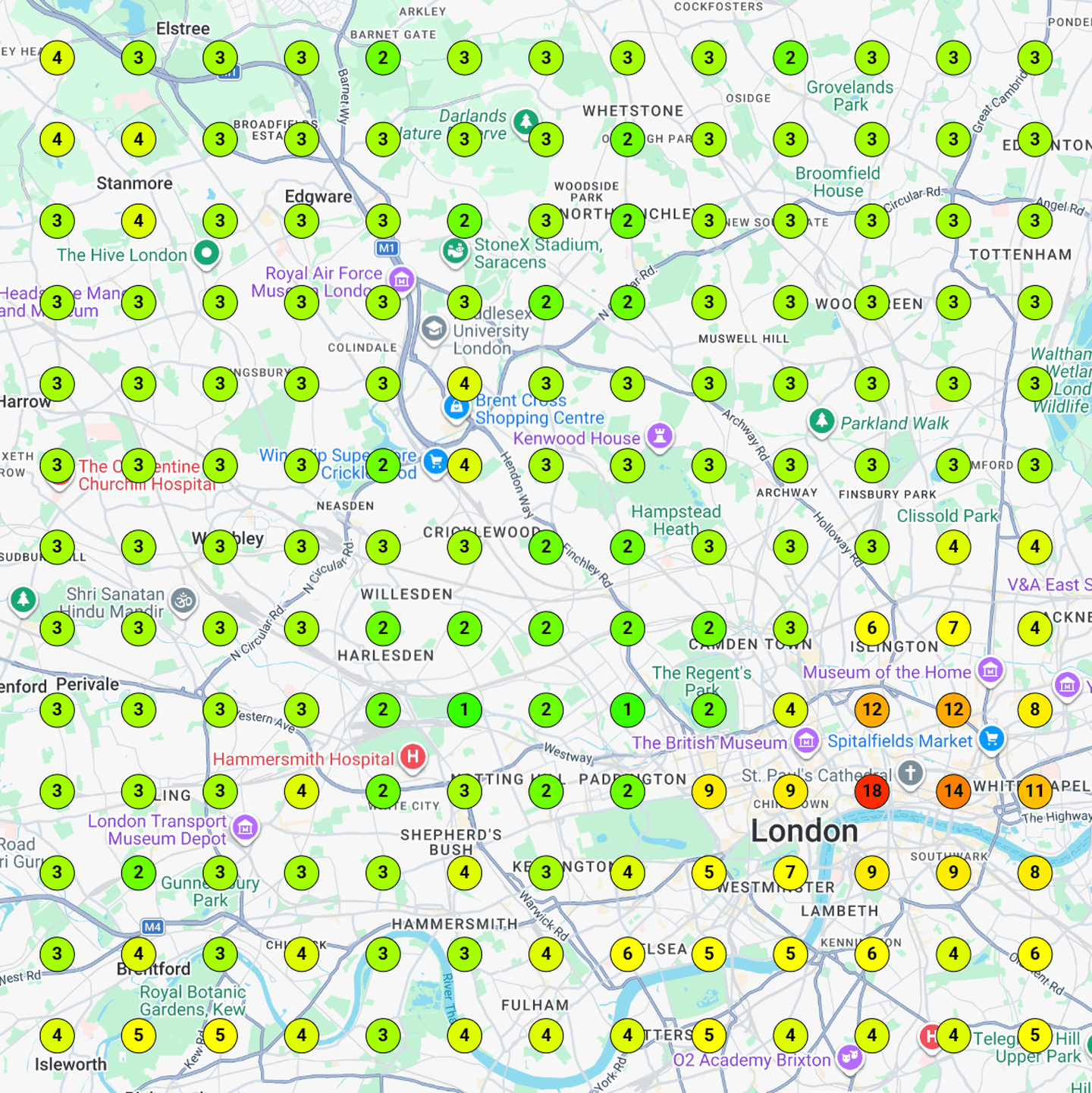
Map scan, 12 June 2026, "bespoke cartier watch straps", 13 by 13 grid across London. Each green point is a spot where INRO comes up in Google's top three.
Most of that grid is green. For a specialist shop in a trade with real competition, that is the map pack across much of the city handed to them, and every green point is a buyer searching for exactly what they make and finding them at the top.
What this means if you run something specialist in a big city
If you run something specialist in a big city, you have probably decided the map is not worth chasing. I would argue it is the other way round. The bigger and busier the city, the more people are searching, and the fewer businesses do exactly the one thing you do. A generalist is fighting everyone at once. A specialist who sets the profile up properly, says the right things on the website and gets listed in the right places is often the single best answer Google has for that search, and it shows you to the people nearest to you first.
You can test where you stand in about a minute. Search your own main service in your city on a phone that is not logged into your account, and see whether you come up on that little map, or whether it is three competitors looking back at you. If it is them, that is where the enquiries are going, and you never see them. You can see the same thing done for other businesses on our results page.
How I measured this
The figures come off dated map scans of Google's local results, read exactly as printed, with nothing rounded or added. The keyword tracked throughout was "bespoke cartier watch straps", across a grid of 169 points covering London. The 71.01% is read straight off the scan on the 12th of June. The early climb from 8.28% to 40.24% is two scans three weeks apart on one fixed grid, so it is a like for like comparison. A green point means INRO came up in Google's top three at that spot.
If you are already making good money but you have written off Google because your city is too crowded, let me show you the real picture. I will scan your own main search across your city for free and send you the same kind of map you have just seen, showing exactly where you come up today. Get your free ranking scan.
J
Runs Rank on Google and Nivoro Marketing from Bishopton, Renfrewshire.